
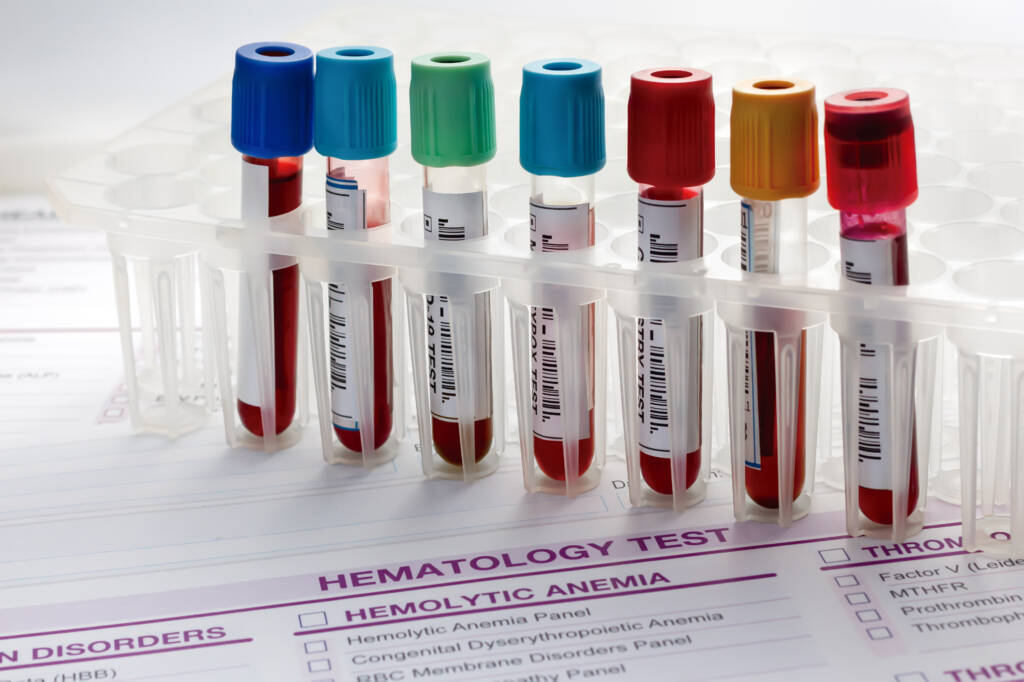
Order Code
2675
Preferred Specimen
Collect 2 mL of serum. Allow the SST tube to clot upright for a minimum of 30 minutes, then centrifuge the sample within 2 hours after collection. Store refrigerated.
For urgent (STAT) requests, please consult your local CPL laboratory regarding specific specimen guidelines.
Note: Avoid collecting samples from patients undergoing high-dose biotin therapy (>5 mg/day) until at least 8 hours after their last biotin dose.
ContainerType
Serum separator tube
Alternate Specimen Requirements
Collect 2 mL of serum using a plain red-top tube. Let the sample clot upright for at least 60 minutes before centrifugation. Transfer the serum to a plastic transport tube within 2 hours of collection, clearly labeling it as serum from a plain red-top tube. Refrigerate after processing.
For STAT orders, please contact your local CPL laboratory to confirm specimen requirements.
Note: Do not collect samples from patients receiving high-dose biotin therapy (>5 mg/day) until a minimum of 5 hours after the last biotin administration.
Minimum Volume
2 mL serum
Transport Temperature
Refrigerated
Expected Turnaround Time
1 day
Specimen Stability
1 day room temperature; 4 days refrigerated; 6 months frozen. Allow only one freeze/thaw cycle
Methodology
Roche COBAS Electrochemiluminescent Immunoassay (ECLIA) or other automated chemistry method this method has been standardized against crm 6004a via id-cg/ms (isotope dilution-gas chromatography/mass spectrometry).
Overview
Estrone (E1), estradiol (E2), and estriol (E3) represent the three principal forms of estrogen. Among these, estradiol (E2) is the most biologically potent endogenous estrogen. In nonpregnant females, the majority of E2 is produced by the ovaries, with smaller amounts originating from peripheral tissues. During pregnancy, the placenta contributes additional estrogen. In males, approximately 75% of E2 is generated by aromatase-mediated conversion of testosterone and other androgens in peripheral tissues, while the remaining 25% is synthesized in the testes.
Clinical Significance
- Evaluation of irregular menses/oligomenorrhea/amenorrhea/hypogonadism
- Evaluation of disorders of puberty (precocious or delayed puberty)
- Infertility assessment and assisted reproduction
- Evaluation of estrogen-producing tumors
- Evaluation of feminization in males
Additional Information
Estradiol (E2) is the predominant and most biologically active estrogen in premenopausal women. It is synthesized primarily through aromatization of androgens (testosterone and androstenedione) and conversion from estrone within the ovary, as well as peripheral androgen conversion. Estrone (E1), produced in the ovary via aromatization of androstenedione and estradiol metabolism, is a moderately potent estrogen found in lower concentrations than E2 in premenopausal women. Estriol (E3), a weak estrogen, is formed peripherally from both estradiol and estrone.
After menopause, ovarian estrogen production ceases. Estrone becomes the predominant estrogen, derived mainly from peripheral conversion of androstenedione. Estradiol levels remain low (<20 pg/mL), produced from peripheral conversion of estrone.
Estrogen levels, particularly E2, fluctuate throughout the menstrual cycle alongside FSH, LH, and progesterone. During the follicular phase (from menstruation onset to ovulation), FSH promotes the growth of ovarian follicles, especially the dominant follicle, stimulating estrogen production. When estrogen concentrations exceed approximately 200 pg/mL, an LH surge triggers ovulation. Estrogen levels then decrease but continue to be secreted by the corpus luteum along with progesterone during the luteal phase (ovulation to menstruation). If pregnancy does not occur, estrogen and progesterone levels fall, leading to menstruation.
Ultrasensitive estradiol assays provide improved detection of low estradiol levels and can be valuable in infertility evaluations, as well as assessment of prepubertal girls, postmenopausal women, and men.
Limitations
- Significant interlaboratory variability is observed, though efforts are underway toward method standardization.
- Serum levels represent values at one point in time.
References
American College of Obstetricians and Gynecologists (ACOG) Committee on Gynecologic Practice. ACOG Committee Opinion No. 322: Compounded bioidentical hormones. Obstet Gynecol. 2005;106(5 Pt 1):1139-40.16260546
Burger HG, Hale GE, Robertson DM, Dennerstein L. A review of hormonal changes during the menopausal transition: focus on findings from the Melbourne Women’s Midlife Health Project. Hum Reprod Update, 2007;13(6):559–565.17630397
Camillo PA. Can FSH levels accurately reflect menopause in women taking oral contraceptives? Medscape website. http://www.medscape.com/viewarticle/529959. Published April 20, 2006. Accessed July 29, 2014.
Choe JK, Khan-Dawood FS, Dawood MY. Progesterone and estradiol in the saliva and plasma during the menstrual cycle. Am J Obstet Gynecol. 1983;147(5):557-562.6638098
Freeman EW, Sammel MD, Gracia CR, et al. Follicular phase hormone levels and menstrual bleeding status in the approach to menopause. Fertil Steril. 2005;83(2):383-392.15705379
Gann PH, Giovanazzi S, Van Horn L, Branning A, Chatterton RT Jr. Saliva as a medium for investigating intra- and interindividual differences in sex hormone levels in premenopausal women. Cancer Epidemiol Biomarkers Prev. 2001;10(1):59-64.11205490
Potischman N, Falk RT, Laiming VA, Siiteri PK, Hoover RN. Reproducibility of laboratory assays for steroid hormones and sex hormone-binding globulin. Cancer Res. 1994;54(20):5363-5367. 7923166
The North American Menopause Society (NAMS). Clinical Evaluation & Counseling. In: Bilancini AM ed. Menopause Practice: A Clinicians Guide. 4th ed. Mayfield Heights, OH: NAMS; 2010:170-194.
Vance ML. Hypopituitarism. N Engl J Med. 1994;330(23):1651-1662.8043090
Wood P. Salivary steroid assays – research or routine? Ann Clin Biochem. 2009;46(Pt 3):183-196.19176642
Young RH and Scully RE. Sex cord-stromal, steroid cell, and other ovarian tumors with endocrine, parendocrine, and paraneoplastic manifestations. In: Kurman RJ, ed. Blaustein’s Pathology of the Female Genital Tract. 4th ed. New York, NY: Springer-Verlag; 1994:783-847
Alias
- d6705
- e2
Test Setup Days
Monday through Friday PM shift
CPT
82670 LOINC: 2243-4
Reference Range
MALES FEMALES
AGE: 7-9 YEARS <=17.0 PG/ML <=51.0 PG/ML
10-12 YEARS <=18.0 PG/ML <=116.0 PG/ML
13-15 YEARS <=51.0 PG/ML <=324.0 PG/ML
16-17 YEARS <=48.0 PG/ML <=346.0 PG/ML
>=18 YEARS <=60.7 PG/ML
FOLLICULAR 12.4-233.0 PG/ML
OVULATION 41.0-398.0 PG/ML
LUTEAL PHASE 22.3-341.0 PG/ML
POSTMENOPAUSAL SUPPLEMENTED/NON-SUP <138.0/<20.0 PG/ML
FOR PATIENTS BETWEEN 10-17 YEARS:
TANNER I <17.0 PG/ML <=76.0 PG/ML
TANNER II <17.0 PG/ML <=175.0 PG/ML
TANNER III <=49.0 PG/ML 20.0-360.0 PG/ML
TANNER IV/V <=49.0 PG/ML <=337.0 PG/ML
| UNIT CODE | UNIT CODE NAME | ANALYTE | GENDER | AGE | REFERENCE RANGE | Units of Measure |
|---|---|---|---|---|---|---|
| 2675 | ESTRADIOL | E26 | NOT SPECIFIED | ALL | SEE BELOW | PG/ML |
| 2675 | ESTRADIOL | E26 | MALE | ALL | <=60.7 | PG/ML |
| 2675 | ESTRADIOL | E26 | FEMALE | ALL | SEE BELOW | PG/ML |