
Order Code
2738
Preferred Specimen
Collect 1 mL of serum.
Allow the serum separator tube (SST) to clot upright for a minimum of 30 minutes, then centrifuge within 2 hours of collection. Store the sample refrigerated.
ContainerType
Serum separator tube
Alternate Specimen Requirements
Acceptable alternative: 1 mL of serum from a plain red-top tube.
Let the sample clot upright for at least 60 minutes, then centrifuge and transfer the serum to a labeled plastic transport tube within 2 hours of collection. Clearly indicate that the sample was obtained from a plain red-top tube. Keep refrigerated.
Minimum Volume
1.0 mL serum
Transport Temperature
Refrigerated
Expected Turnaround Time
2 days
Specimen Stability
4 days room temperature; 7 days refrigerated; 4 months frozen
Methodology
Roche COBAS Electrochemiluminescence Immunoassay (ECLIA).
Overview
Hepatitis B virus (HBV) is a circular, partially double-stranded DNA virus belonging to the Hepadnaviridae family. It is not related to the viruses responsible for Hepatitis A or C. Transmission occurs through contact with infected bodily fluids, which may include sexual exposure, shared intravenous drug use, or perinatal exposure from an infected mother during childbirth.
HBV infection can be classified as acute or chronic, with liver damage arising primarily from the host immune response aimed at eliminating the virus. Acute infection typically presents within six months of exposure and may include symptoms such as jaundice, nausea, and vomiting. In the United States, approximately 5% of acute HBV cases progress to chronic infection, although this rate is significantly higher when infection occurs during infancy or early childhood.
Chronic HBV is a long-term illness that carries a substantial risk for cirrhosis and hepatocellular carcinoma (CDC, 2012).
Diagnosis is made using HBV-specific serologic markers, which help determine the phase of infection (acute, chronic, past infection, or immunity) and identify individuals at higher risk for complications.
- The hepatitis B surface antibody (HBsAb) indicates either recovery and immunity from past infection or a successful response to vaccination.
- Differentiation between natural infection and vaccine-induced immunity is made through testing for the hepatitis B core antibody (anti-HBc), which is not present following vaccination. Detection of IgM and/or IgG anti-HBc suggests prior or ongoing infection.
(Adapted from CDC, 2012)
Clinical Significance
- Part of initial screening for acute hepatitis (new onset jaundice, anorexia, and/or dark urine) along hepatitis B surface antigen (HBsAg) and hepatitis A virus IgM
- Evaluation of elevated liver enzymes
- Evaluation of exposure risk following needlestick injuries in healthcare facilities to guide use of hepatitis B immune globulin
- Evaluation for prior vaccination
- Recommended only in certain at-risk populations (eg, hemodialysis patients, HIV-positive patients with high-risk lifestyle, post needlestick evaluation)
Additional Information
The incubation period for HBV is 45 to 160 days, with an average of 100 days for symptom onset. The acute illness is typically mild (especially in young children), however 30% to 50% of adolescents and adults will present with symptoms (jaundice, anorexia, nausea, vomiting). The disease may become fulminant in 0.1% to 0.5% of acute HBV infections (O’Shea 2010), and acute clinical deterioration of an individual with the HBV should prompt evaluation for hepatitis D virus superinfection. See Hepatitis D Virus Antibody, Total, Serum.
Risk factors for HBV transmission include living in a household with an HBV-infected person, sexual contact with an HBV-infected person, men who have sex with men, immigrants from regions of high HBV infectivity, renal dialysis, concurrent use of immunosuppression medication, HIV infection, abnormal liver enzymes, inmates, intravenous drug use (WHO 2014).
Hepatitis B Laboratory Studies Interpretation
| Test | Alternative Names | Result | Interpretation |
|---|---|---|---|
| HBsAg | Hepatitis B Surface Antigen | Negative | No prior or active infection and thus susceptible |
| HBcAb | Hepatitis B Core Antibody; Anti-HBc (IgM, IgG) | Negative | |
| HBsAb | Hepatitis B Surface Antibody; Anti-HBs | Negative | |
| HBsAg | Hepatitis B Surface Antigen | Negative | Infection resolved and immune to HBV due to natural infection (but can reactivate if immunosuppressed) |
| HBcAb | Hepatitis B Core Antibody; Anti-HBc (IgM, IgG) | Positive | |
| HBsAb | Hepatitis B Surface Antibody; Anti-HBs | Positive | |
| HBsAg | Hepatitis B Surface Antigen | Negative | Immune to HBV due to vaccination |
| HBcAb | Hepatitis B Core Antibody; Anti-HBc (IgM, IgG) | Negative | |
| HBsAb | Hepatitis B Surface Antibody; Anti-HBs | Positive | |
| HBsAg | Hepatitis B Surface Antigen | Positive | Acutely infected |
| HBcAb | Hepatitis B Core Antibody; Anti-HBc (IgM, IgG) | Positive | |
| HBsAb | Hepatitis B Surface Antibody; Anti-HBs | Negative | |
| HBsAg | Hepatitis B Surface Antigen | Positive | Chronically infected |
| HBcAb IgM | Hepatitis B Core Antibody, IgM; Anti-HBc IgM | Negative | |
| HBcAb IgG | Hepatitis B Core Antibody IgG; Anti-HBc IgG | Positive | |
| HBsAb | Hepatitis B Surface Antibody; Anti-HBs | Negative | |
| HBsAg | Hepatitis B Surface Antigen | Negative | Four possible clinical scenarios:• Resolving acute infection (the window period)• Resolved infection (most common)• False-positive HBcAb• Low-level chronic infection |
| HBcAb | Hepatitis B Core Antibody; Anti-HBc (IgM, IgG) | Positive | |
| HBsAb | Hepatitis B Surface Antibody; Anti-HBs | Negative | |
| HBeAg | Hepatitis B Be Antigen; HBeAg | Positive | Active viral replication with high level of infectivity which may be seen in acute HBV or actively replicating chronic HBV |
| HBeAb | Hepatitis B Be Antibody; Anti-HBe | Positive | • Resolved acute HBV infection• Inactive (nonreplicating) chronic infection |
| HBsAg | Hepatitis B Surface Antigen | Positive | Asymptomatic chronic carrier with normal LFTs, nonactive viral replication and noninfectious |
| HBcAb IgG | Hepatitis B Core Antibody IgG; Anti-HBc IgG | Positive | |
| HBeAg | Hepatitis Be Antigen | Negative | |
| HBV DNA | Hepatitis B DNA | Negative |
Interpretative Information
<10 IU/L: Negative
- No evidence of prior exposure to HBV or hepatitis B vaccination
≥10 IU/L: Positive
- After infection with HBV, HBsAb is first seen during convalescence, indicating recovery and immunity; persists for life.
- Presence means individual is no longer contagious for the HBV.
- Following vaccination: Positive immunization response; Note: Assessing the effectiveness of the vaccine is only recommended for patients with impaired immune systems (eg, HIV, hemodialysis patients) and is best done between 2-4 weeks after the final vaccination in the series (Kaplan, 2009).
- Not found in patients with chronic HBV.
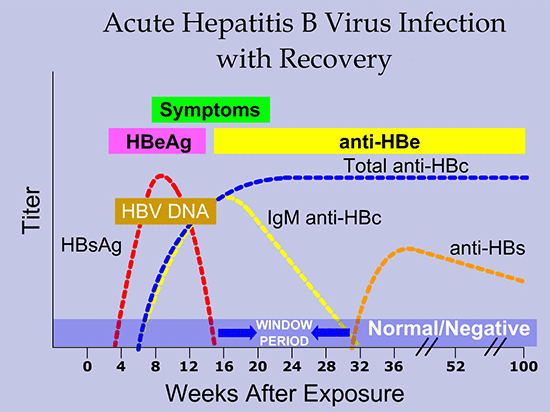
Image obtained from CDC, with permission June, 2014
Limitations
False-negative results:
- Waning HBsAb-titer levels over time. At present, these patients are still believed to be protected for up to 23 years by the anamnestic response which allows the body to mount an effective response to an infection with the HBV (CDC, 2012).
False-positive results:
- As there are different serologic subtypes of hepatitis B virus, it is possible (and has been reported) for a patient to have antibody to one surface antigen type and to be acutely infected with virus of a different subtype. Thus, a patient may have coexisting (and unrelating) HBsAg and HBsAb.
- Transfused individuals or hemophiliacs receiving plasma components may have passively acquired HBsAb from transfusion; does not indicate immunity.
- Most individuals vaccinated with HBV vaccine develop HBsAb, although some do not.
References
Ask the experts: diseases & vaccines. Immunization Action Coalition website. http://www.immunize.org/askexperts/experts_hepb.asp Reviewed July, 2014. Accessed July 29, 2014.
Elgouhari HM, Abu-Rajab Tamimi TI, Carey W. Hepatitis B: a strategy for evaluation and management. Cleve Clin J Med. 2009;76(1):19-35.19122108
Ganem D, Prince AM. Hepatitis B virus infection–natural history and clinical consequences. N Engl J Med. 2004;350(11):1118-1129.15014185
Hepatitis B. World Health Organization website. http://www.who.int/mediacentre/factsheets/fs204/en/. Updated July 2014. Accessed July 23, 2014.
Hepatitis B Information for Health Professionals. Centers for Disease Control and Prevention website. http://www.cdc.gov/hepatitis/HBV/index.htm. Updated May 16, 2012. Accessed July 9, 2014.
Janssen HL, van Zonneveld M, Schalm SW. Hepatitis B. N Engl J Med. 2004;350(26):2719-2720.15215493
Kaplan JE, Benson C, Holmes KK, Brooks JT, Pau A, Masur H. Guidelines for prevention and treatment of opportunistic infections in HIV-infected adults and adolescents: recommendations from CDC, the National Institutes of Health, and the HIV Medicine Association of the Infectious Diseases Society of America. MMWR Recomm Rep. 2009;58(RR-4):1-20719357635
Kuo A, Gish R. Chronic hepatitis B infection. Clin Liver Dis. 2012;16(2):347-369.22541703
Lok AS, McMahon BJ. Chronic hepatitis B. Hepatology. 2007:45(2):507-539.17256718
Lok AS, McMahon BJ. Chronic hepatitis B: update 2009. Hepatology. 2009;50(3):661-662.19714720
O’Shea RS. Hepatitis B. Cleveland Clinic Center for Continuing Education website. http://www.clevelandclinicmeded.com/medicalpubs/diseasemanagement/hepatology/hepatitis-B/. Published August 2010. Accessed July 9, 2014.
Sacher RA, Peters SM, Bryan JA. Testing for viral hepatitis. A practice parameter. Am J Clin Pathol. 2000;113(1):12-7.10631853
World Health Organization; Department of Communicable Disease Surveillance and Response. Hepatitis Delta. http://www.who.int/csr/disease/hepatitis/HepatitisD_whocdscsrncs2001_1.pdf?ua=1. Published December 2001. Accessed April 22, 2014.
Diagnostic Role
Hepatitis B surface antibody (HBsAb) is produced in response to the hepatitis B surface antigen (HBsAg). It is detectable approximately six months after infection, and as early as 8-10 weeks after symptom onset. In serologic testing, the time interval between the clearance of HBsAg and the appearance of HBsAb is termed the ‘window-period’. The advent of the HBsAb, which is a neutralizing antibody and protective against reinfection, indicates clearance of the HBV and noninfectivity. HBsAb persists for life.
An individual negative for HBsAg and positive for HBsAb has either cleared the HBV infection, or has received prior vaccination against HBV. These results can be further clarified by testing for the presence of hepatitis B core antibody (HBcAb): HBsAb detected in the presence of HBcAb indicates prior infection; HBsAb detected alone indicates successful vaccination. It is important to note that HBsAb titers may fall to undetectable level after infection, with only HBcAb (IgG) remaining detectable to document prior infection.
Current immunization protocols use HBsAg produced by recombinant DNA technology to induce HBsAb. Prevaccination screening for HBsAb is not recommended except in high-risk populations (eg, intravenous drug users, men who have sex with men). Routine postvaccination HBsAb titer evaluation is an area of much controversy, and recommendations have yet to be standardized. The CDC bases its advice on multiple considerations, including an individual’s immunocompetency, risk for occupational exposure, as well as the results of any initial postvaccination series testing. Booster doses may be appropriate for high-risk patients if titers of HBsAb fall below what is considered protective (10 IU/mL) (O’Shea, 2010; Sacher, 2000). It is relevant to note that vaccine recipients may test transiently positive for HBsAg during the first two weeks following immunization.
Passively acquired HBsAb, as from transfusion or recent immune globulin therapy, does not convey immunity.
Alias
- Hep B quantitative “immune status
- Hepatitis B immune status
- Hepatitis B S antibody,quantitative
- Hepatitis B Surface antibody titer
- quantitative Hepatitis B S antibody
Test Setup Days
Monday through Friday PM shift
CPT
86706 LOINC:
Hepatitis Bs AB Quant: 16935-9
Hepatitis Bs AB Interp: 22322-2
Reference Range
NON-REACTIVE: <10.0 MIU/ML
REACTIVE: >=10.0 MIU/ML
| UNIT CODE | UNIT CODE NAME | ANALYTE | GENDER | AGE | REFERENCE RANGE | Units of Measure |
|---|---|---|---|---|---|---|
| 2738 | HEP B AB QUANT | HEPINTP | NOT SPECIFIED | ALL | SEE BELOW | |
| 2738 | HEP B AB QUANT | HEPINTP | MALE | ALL | SEE BELOW | |
| 2738 | HEP B AB QUANT | HEPINTP | FEMALE | ALL | SEE BELOW | |
| 2738 | HEP B AB QUANT | HEPBQNT | NOT SPECIFIED | ALL | SEE BELOW | MIU/ML |
| 2738 | HEP B AB QUANT | HEPBQNT | MALE | ALL | SEE BELOW | MIU/ML |
| 2738 | HEP B AB QUANT | HEPBQNT | FEMALE | ALL | SEE BELOW | MIU/ML |