
Order Code
1425
Preferred Specimen
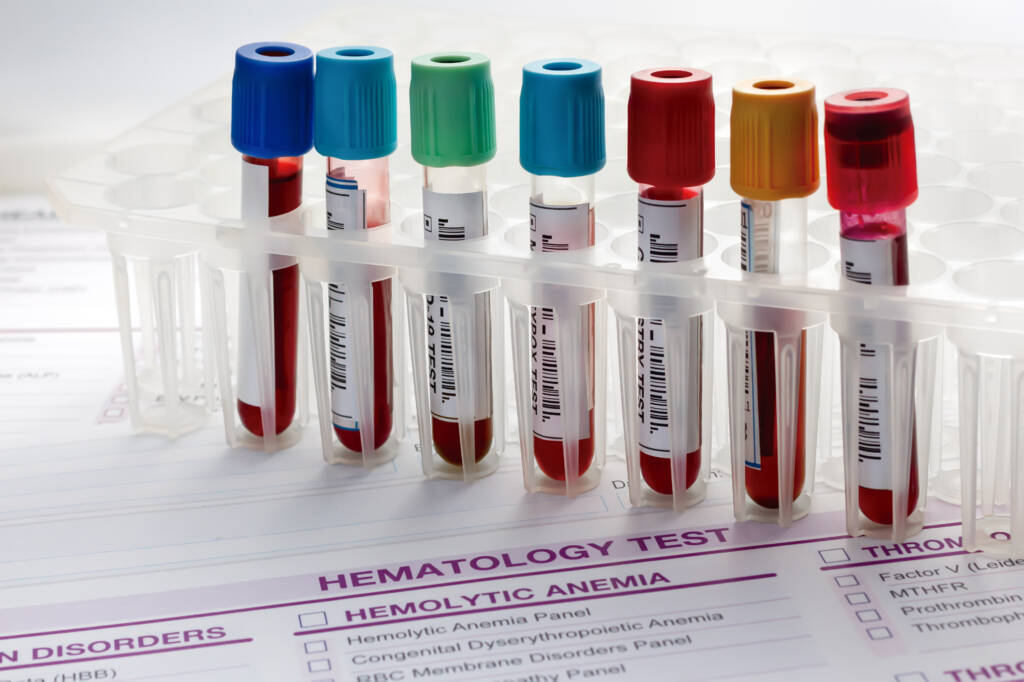
Submit a completely filled citrate (light blue-top) tube.
Do not open the tube. Maintain at Critical Room Temperature (CRT).
ContainerType
Completely filled citrate (light blue top) tube
Alternate Specimen Requirements
Provide 2 mL of plasma from a citrate (light blue-top) tube.
Immediately centrifuge and separate plasma from cells. Transfer plasma to a plastic transport tube and label clearly as “citrate plasma”.
Specimen must be frozen and maintained at Critical Frozen (CFZ) temperature.
If multiple tests are ordered, submit a separate tube for each.
Minimum Volume
Completely filled citrate tube
Transport Temperature
Critical Room Temperature (crt) for whole blood, Critical Frozen (cfz) for plasma
Expected Turnaround Time
1 day
Specimen Stability
Whole blood: 1 day room temperature if unopened plasma: 2 weeks frozen
Methodology
Automated electromechanical clot detection
Rejection Criteria
Hemolysis
clotted samples
samples submitted in tube that is not completely filled
samples submitted in inappropriate anticoagulant
samples submitted in expired tube
refrigerated samples
Overview
The Prothrombin Time (PT) test evaluates the functionality of the extrinsic and common coagulation pathways by measuring the time it takes for a clot to form following activation of Factor VII through fibrin formation. A prolonged PT indicates a deficiency or inhibition in one or more clotting factors involved in these pathways.
Common Causes of Prolonged PT
Inherited Causes:
- Deficiencies in Factor II, V, VII, X, or fibrinogen
Acquired Causes:
- Antiphospholipid syndrome (coagulopathy caused by antiphospholipid antibodies)
- Warfarin therapy (used to prevent or treat thromboembolic conditions)
- Liver dysfunction
- Vitamin K deficiency
- Disseminated Intravascular Coagulation (DIC)
- Development of inhibitory antibodies against coagulation factors
Warfarin Monitoring and INR - Warfarin is an oral anticoagulant that impairs the activation of vitamin K-dependent clotting factors (II, VII, IX, X). Because of its narrow therapeutic range, patients on warfarin require regular monitoring using PT/INR testing.
- In testing, patient plasma is combined with thromboplastin and calcium, and the time until clot formation is recorded.
- However, due to differences in thromboplastin reagents and laboratory instruments, PT results can vary significantly between labs. To standardize these results, the International Normalized Ratio (INR) was developed: INR=(Patient PTMean Normal PT)ISI\text{INR} = \left( \frac{\text{Patient PT}}{\text{Mean Normal PT}} \right)^{\text{ISI}}INR=(Mean Normal PTPatient PT)ISI
- ISI (International Sensitivity Index): A calibration value provided by the thromboplastin manufacturer based on reagent lot and instrumentation.
Clinical Significance - The INR has become the standard for reporting PT results in patients on warfarin therapy. It ensures consistency across different laboratories and testing platforms, reducing variability and improving patient safety during anticoagulation management.
Clinical Significance
- Preoperative screen to assess the integrity of the extrinsic (factor VII) and common pathways (fibrinogen and factors II, V, and X) of coagulation
- Monitor warfarin therapy
- Warfarin management
- Warfarin genomics
- Coagulopathy evaluation
- Assessment of liver function
- Assessment of nutritional status
Additional Information
Acquired causes of PT prolongations are much more common than hereditary causes (see list below). The liver synthesizes all of the coagulation factors; therefore, with liver disease, multiple factor deficiencies can develop which prolong PT earlier and more than the PTT. Warfarin or vitamin K deficiency impair the function of factors II, VII, IX, and X, leading to PT and eventually PTT prolongations. In disseminated intravascular coagulation (DIC), multiple factor deficiencies may arise due to activation and consumption of factors, prolonging PT more often than PTT. Heparin inhibits activated factors II, X, IX, XI, XII, and kallikrein by enhancing antithrombin activity, prolonging PTT more than PT. Hirudin and argatroban inhibit only activated factor II (thrombin), prolonging PT and PTT.
CAUSES OF PT PROLONGATIONS:
Acquired:
- Liver dysfunction (PT affected earlier and more than PTT)
- Vitamin K deficiency (PT affected earlier and more than PTT)
- Warfarin (PT affected earlier and more than PTT)
- Disseminated intravascular coagulation (DIC) (PT affected earlier and more than PTT)
- Lupus anticoagulants (may or may not prolong PTT; PT is rarely prolonged)
- Heparin (PT less affected than PTT; PT may be normal)
- Hirudin or argatroban (PTT also prolonged)
- Specific factor inhibitors (PTT also prolonged except in the rare case of an inhibitor against factor VII)
Hereditary:
Deficiency of fibrinogen or factors II, V, or X (PTT may also be prolonged)
Deficiency of factor VII (PTT is normal)
Limitations
- Prothrombin time is sensitive to the plasma to citrate anticoagulant ratio. If the collection tube is not filled to normal capacity, a falsely elevated prothrombin time may result.
- Hematocrits >55% may falsely increase PT result; there is a decreased plasma to anticoagulant ratio.
- Heparin can prolong PT, depending on thromboplastin used. Some reagents contain a heparin neutralizer to reduce or eliminate heparin interference.
- INR calculation errors can occur. Analyzer calculation is recommended.
- INR is less reliable early in warfarin therapy (especially with results from different laboratories).
- Presence of lupus anticoagulants may artificially increase PT result. Lupus anticoagulants in the plasma can inhibit or block the clotting process in vitro, thus increasing PT results.
References
Adcock Funk DM, Lippi G, Favaloro EJ. Quality standards for sample processing, transportation, and storage in hemostasis testing. Semin Thromb Hemost. 2012 Sep;38(6):576-85. doi: 10.1055/s-0032-1319768. Epub 2012 Jun 16.22706973
Bajaj SP and Joist JH, “New Insights Into How Blood Clots: Implications for the Use of APTT and PT as Coagulation Screening Tests and in Monitoring of Anticoagulant Therapy,” Semin Thromb Hemost, 1999, 25(4):407-18.10548073
Bamberg R, Cottle JN, and Williams JC, “Effect of Drawing a Discard Tube on PT and APTT Results in Healthy Adults,” Clin Lab Sci, 2003, 16(1):16-9.12587654
Burns ER, Goldberg SN, and Wenz B, “Paradoxic Effect of Multiple Mild Coagulation Factor Deficiencies on the Prothrombin Time and Activated Partial Thromboplastin Time,” Am J Clin Pathol, 1993, 100(2):94-8.8356955
Center for Phlebotomy Education. The Order of Draw: Do I have to follow it? https://www.phlebotomy.com/the-order-of-draw.html. Accessed April 12, 2021.
Clinical Laboratory Standards Institute, Collection, Transport, and Processing of Blood Specimens for Coagulation Testing and General Performance of Coagulation Assays: Approved Guideline 3rd Edition CLSI Document H21-A3, CLSI: Wayne, PA, 1998.
Clinical Laboratory Standards Institute (CLSI). Collection, Transport, and Processing of Blood Specimens for Testing Plasma-Based Coagulation Assays and Molecular Hemostasis Assays; Approved Guidelines. Fifth Edition. CLSI document H21-A5. Wayne, PA: Clinical Laboratory Standards Institute; 2008.
Clinical Laboratory Standards Institute (CLSI). Order of Blood Draw Tubes and Additives. https://clsi.org/about/blog/order-of-blood-draw-tubes-and-additives/. Published March 19, 2019. Accessed February 9, 2021.
Fairweather RB, Ansell J, van den Besselaar AM, et al, “College of American Pathologists Conference XXXI on Laboratory Monitoring of Anticoagulant Therapy. Laboratory Monitoring of Oral Anticoagulant Therapy,” Arch Pathol Lab Med, 1998, 122(9):768-81.9740135
Fischer KG, “Hirudin in Renal Insufficiency,” Semin Thromb Hemost, 2002, 28(5):467-82.12420243
Gottfried EL and Adachi MM, “Prothrombin Time and Activated Partial Thromboplastin Time Can Be Performed on the First Tube,” Am J Clin Pathol, 1997, 107(6):681-3.9169665
Hirsh J, Fuster V, Ansell J, et al, “American Heart Association/American College of Cardiology Foundation Guide to Warfarin Therapy,” Circulation, 2003, 107(12):1692-711.12668507
McGlasson DL, “Laboratory Variables That May Affect Test Results in Prothrombin Times (PT)/International Normalized Ratios (INR),” Laboratory Medicine, 2003, 34(2):124-9.
Moll S and Ortel TL, “Monitoring Warfarin Therapy in Patients With Lupus Anticoagulants,” Ann Intern Med, 1997, 127(3):177-85.9245222
Sanfelippo MJ, Sennet J, and McMahon EJ, “Falsely Elevated INRs in Warfarin-Treated Patients With Lupus Anticoagulant,” WMJ, 2000, 99(3):42-4, 43.10927985
Shapiro SS, “Treating Thrombosis in the 21st Century,” N Engl J Med, 2003, 349(18):1762-3.14585945
van der Besselaar, AMHP, “Standardization and Control of Oral Anticoagulant Therapy,” Advanced Laboratory Methods in Haematology, Part 6, Chapter 8, Rowan RM, van Assendelft OW, and Preston FE, eds, London, UK: Arnold, 2002, 386-417.
Zehnder JL. Clinical Use of Coagulation Tests. In: Post TW, ed. UpToDate. Waltham, MA: UpToDate; 2017. https://www.uptodate.com/. Accessed April 27, 2018.
Alias
- Inr protime
- Protime (pt)
- Pt (protime)
- Pt w/inr
Test Setup Days
Sunday through Saturday 24 hours a day
CPT
85610 Limited Coverage Test For Medicare.
Advance Beneficiary Notice Of Non-Coverage (ABN) Required
If Diagnosis Is Not Covered
LOINC:
Pt: 3289-6
Inr: 6301-6
Reference Range
12.5-14.7 SECONDS
CURRENT RECOMMENDATIONS ARE FOR AN INR OF 2.0-3.0 FOR ALL
ANTICOAGULATED PATIENTS EXCEPT THOSE WITH PROSTHETIC HEART
VALVES WHERE AN INR OF 2.5-3.5 IS RECOMMENDED.
| UNIT CODE | UNIT CODE NAME | ANALYTE | GENDER | AGE | REFERENCE RANGE | Units of Measure |
|---|---|---|---|---|---|---|
| 1425 | PT | PT | NOT SPECIFIED | ALL | 12.5-14.7 | SECONDS |
| 1425 | PT | PT | MALE | ALL | 12.5-14.7 | SECONDS |
| 1425 | PT | PT | FEMALE | ALL | 12.5-14.7 | SECONDS |
| 1425 | PT | INR | NOT SPECIFIED | ALL | SEE BELOW | |
| 1425 | PT | INR | MALE | ALL | SEE BELOW | |
| 1425 | PT | INR | FEMALE | ALL | SEE BELOW |